
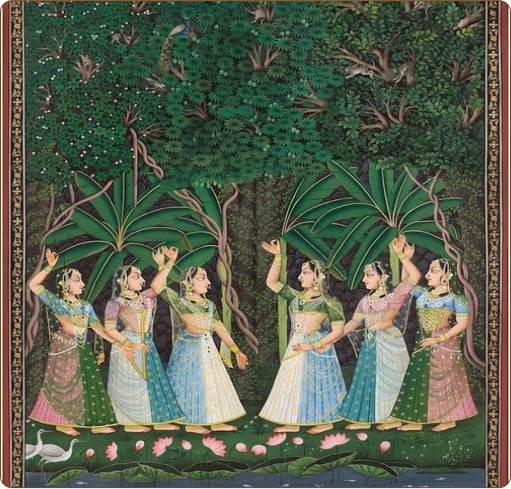
Devotion in Music: Bhakti and Sufi Traditions in Classical Melodies
The Bhakti Movement, originating in South India in the 8th century and reaching its pinnacle in the 17th century, was a pan-Indian phenomenon that resulted in a profusion of devotional poetry. Although the formal movement ceased after the 17th century, devotional poetry continued to be an integral part of Indian literature. The term ‘bhakti’ itself was first used in the 1st millennium BCE, appearing in the Shvetashvatara Upanishad, the Katha Upanishad, and the Bhagavad Gita. The Shvetashvatara Upanishad, embedded in the Yajur Veda, serves as a foundational text for Vedanta philosophy, Saivism, and Yoga principles.
A notable verse in the Shvetashvatara Upanishad, dating back to 6.23, introduces the term ‘Bhakti’ and emphasizes love and devotion to God and the teacher (Guru). This verse is regarded as one of the earliest mentions of “the love of God.” Bhakti, as an emotional devotion to a personal God, is a central theme in Indian spirituality. The Bhakti marg, or the path of devotion, is considered one of the ways to attain moksha or liberation – the ultimate goal of spiritual development. The Shvetashvatara Upanishad is crucial in the context of the Bhakti movement as it contains one of the earliest mentions of the term ‘Bhakti.’ This Upanishad introduces the concept of emotional devotion to a personal God, a theme that became central to the Bhakti movement, influencing devotional poetry and spiritual practices.
The Bhakti movement, which spread across medieval India, saw poets expressing loving devotion to incarnations of Vishnu, particularly Rama and Krishna. It marked a rebellion against superficial Brahminical customs, caste distinctions, and discriminatory practices. Bhakti poets like Kabir, Ravi Das, Meera Bai, Chaitanya, and others played a crucial role in spreading the movement’s ideals.
These saint-poets emphasized spiritual union with the Lord through their soulful poetry, which had a profound impact on society. The Bhakti movement advocated a liberal outlook, encouraging individual choice in worship and conveying a social message of devotion and freedom in spiritual practices. Kabir’s Dohas, simple yet impactful couplets, exemplify the mass appeal and social influence of the Bhakti movement.
During the period of the rise and spread of the Bhakti movement in India, the country also witnessed the advent of Islam, particularly with the ascendancy of the Mughal Empire from the 16th to the 19th century. The Mughal Empire, which began with Babur in 1526 and lasted until the death of Aurangazeb in 1707, played a significant role in shaping India’s socio-political landscape. However, within fifty years of Aurangazeb’s death, the Mughal Empire faced challenges such as weak successors, financial difficulties, the rise of regional Hindu kingdoms, and the establishment of British rule by the East India Company, leading to its eventual disintegration. Throughout the dominance of the Mughals, the Islamic religion of the conquerors maintained a certain hostility toward Hinduism. Islamic critiques often focused on Hindu practices such as polytheism (worship of many gods), idolatry (idol worship), and what they perceived as irrational rituals. Islam, in its early interactions with Hinduism, tended to overlook the core binding principle of Hinduism—the acceptance and adherence to multiple faiths and various forms of worship practiced by different religions. This acceptance is fundamental to the Hindu idea of universal brotherhood.
As tensions grew between the two religions, resulting in mutual animosity, a group of religious thinkers emerged from both the Hindu Bhakti movement and the Islamic Sufi movement. These thinkers played a crucial role in bridging the divide between the two religious orders, fostering love, friendship, and feelings of fellowship and fraternity among people. The Sufi movement, in particular, was influenced by Hindu ideas, as Sufi thinkers undertook in-depth studies of Vedanta and the philosophies of Buddhism and Jainism—both considered offshoots of Hinduism. This intellectual exchange between Hinduism and Islam, facilitated by the Bhakti and Sufi movements, helped promote mutual understanding and harmony between the followers of the two religions, contributing to a more pluralistic and syncretic cultural landscape in India.
Sufi music, a genre deeply rooted in the devotional practices of Sufism, the mystical branch of Islam, draws inspiration from the profound works of Sufi poets like Rumi, Hafiz, Bulleh Shah, Amir Khusrow, and Khwaja Ghulam Farid. Among the various forms of Sufi music, Qawwali stands out as the most well- known, particularly prevalent in the Sufi culture of South Asia. This form involves devotional singing with themes often revolving around love, devotion, and spiritual longing. Qawwali includes vocal improvisation and has become a powerful expression of Sufi mysticism.
The Sema ceremony, associated with the whirling dervishes, is another significant form of Sufi music. Set to a piece called Ayin, this ceremony features vocal and instrumental components, with Turkish classical instruments such as the ney (reed flute) playing a prominent role. Beyond South Asia, Sufi practices have influenced various musical traditions, from West African gnawa to regions spanning Indonesia, Afghanistan, and Morocco. Sufi love songs are often performed in the ghazal and Kafi genres, characterized by solo performances accompanied by percussion and harmonium. The lyrics typically draw from the poetic works of Sufi poets and express themes of divine love and spiritual devotion.
Notable musicians have played a crucial role in popularizing Sufi music across different cultures. Abida Parveen, a Pakistani Sufi singer, is revered as one of the finest vocalists in the modern era. Sanam Marvi, another Pakistani singer, has gained recognition for her soulful Sufi vocal performances. A. R. Rahman, the Oscar-winning Indian musician, has composed several pieces inspired by the Sufi genre, contributing to the global appeal of Sufi music. In addition to South Asian artists, Sufi music has found expression in the works of musicians worldwide. Madonna incorporated Sufi elements, including a depiction of a Sufi ritual with whirling dervishes, in her 1994 song “Bedtime Story.” Canadian singer/songwriter Loreena McKennitt drew inspiration from Sufi music and poetry in her album “The Mask and Mirror.” The genre has even influenced non-Sufi artists like Tori Amos, demonstrating the widespread impact of Sufi musical traditions across diverse cultural landscapes.