

How Dance and Music Move Together: Exploring their Beautiful Bond
Indian classical dance, known as Shastriya Nritya, encompasses various regionally-specific traditions rooted in Hindu musical theatre performance. The theoretical and practical aspects of these dance forms can be traced back to the ancient Sanskrit text Natya Shastra. The number of recognized classical dance styles varies, with the Sangeet Natak Academy recognizing eight main forms: Bharatanatyam, Kathak, Kuchipudi, Odissi, Kathakali, Sattriya, Manipuri, and Mohiniyattam. The Indian Ministry of Culture includes Chhau, making it nine styles. Some scholars also add Chhau, Yakshagana, and Bhagavata Mela to the list.
Each classical dance tradition originates from and is associated with a specific state or region in India. For instance, Bharatanatyam is from Tamil Nadu, Odissi from Odisha, and Manipuri from Manipur. The music accompanying these dance forms includes compositions in various Indian languages, representing a unity of core ideas with diverse styles, costumes, and expressions. Indian classical dancing has its origins around 200 BCE in joyful and celebratory activities, often in devotion to Hindu deities. Performances typically narrate stories of gods and historical accounts. All classical dance styles are vibrant, expressive, and spiritual. Professional dancers, who have dedicated years to study and practice, usually perform these styles at festivals, universities, cultural events, and more.
Dancers wear traditional clothing such as sarees, lenghas, and kurtas during classical Indian performances. Women are the main performers, though men also participate. Women’s costumes consist of long, colorful gowns without shoes, adorned with intricate embroidery and beading. Ornate jewelry, including necklaces, rings, earrings, nose- rings, bracelets, and anklets with attached bells for rhythmic effects, is an essential part of the costume. Women also wear headpieces or scarves, and elaborate facial makeup to embody their characters.
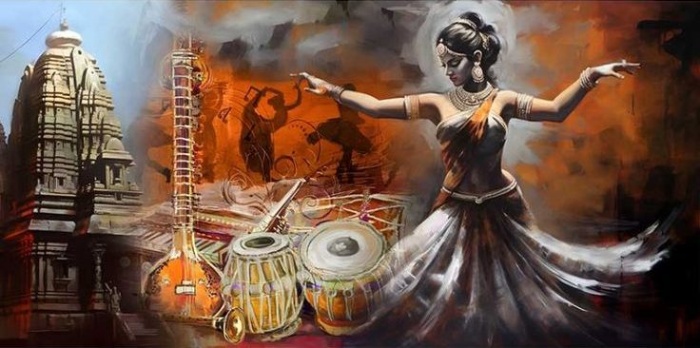
The Natya Shastra, attributed to the ancient scholar Bharata Muni, is the foundational treatise for classical dances of India. It dates between 200 BCE and 200 CE, providing theoretical foundations for various aspects of Indian classical dances, including Tāṇḍava dance (Shiva), rasa, bhāva, gestures, acting techniques, basic steps, and standing postures. Classical dances are considered spiritual paths that liberate the soul, labeled as margi, in contrast to the regional popular practice known as desi. Performances are either religious, taking place inside Hindu temples, or entertainment-oriented, occurring in temple grounds, fairgrounds, royal courts, or public squares during festivals. Ancient and medieval Sanskrit texts like Abhinaya Darpana, Abhinava Bharati, Natya Darpana, and Bhava Prakasa further discuss and expand on the classical repertoire of performance arts.
The seven major Indian classical dance forms are briefly described:
1. Bharatanatyam: Originating from Tamil Nadu, it combines emotion, music, rhythm, and expression, using eye and hand movements to convey feelings.
2. Kathak: Originating from North India, it is a narrative dance form with fast footwork, spins, and expressive abhinaya, telling stories through hand gestures, foot movements, and facial expressions.
3. Kathakali: Originating from Kerala, it combines five elements, emphasizing facial expressions, rhythm, and hand gestures, with therapeutic benefits in exercising facial muscles.
4. Odissi: Originating from Orissa, it follows tribhangi, involving therapeutic movements such as sitting, walking, leaping, and elevations.
5. Kuchipudi: Originating from Andhra Pradesh, it is vachika abhinaya oriented, emphasizing graceful and fluid movements.
6. Manipuri: Originating from Manipur, it is devotional, portraying Hindu deities with delicate and lyrical movements, offering therapeutic benefits in body control and peace of mind.
7. Mohiniattam: Originating from Kerala, performed by women, it translates to “dance of enchantress,” with therapeutic value in body movements, balancing, expression, and muscle control.
Dance/Movement Therapy (DMT), defined by the American Dance Therapy Association (ADTA), employs movement to enhance emotional, social, cognitive, and physical integration, promoting health and well- being. This literature review compares Indian classical dances and DMT, analyzing their shared benefits. It also explores the connection between expressive elements in Indian Classical Dances and Marian Chace’s DMT framework. Ultimately, it suggests further research to consider these dances as potential DMT techniques.
Indian classical dances reflect the traditional culture of India, making them relatable to the people. These dances, such as Bharatnatyam, Kathak, Kathakali, Odissi, Kuchipudi, Manipuri, and Mohiniattam, involve body movements, gestures, and facial expressions to convey emotions. They share common aspects like Natya, Nritta, and Nritya, with key elements like Abhinaya, Gestures, and Navarasas. This review focuses on Abhinaya, Gestures, and Navarasas, considering their role as tools for expressing narratives through movement. These elements are seen as therapeutic, benefiting individuals’ overall well-being.